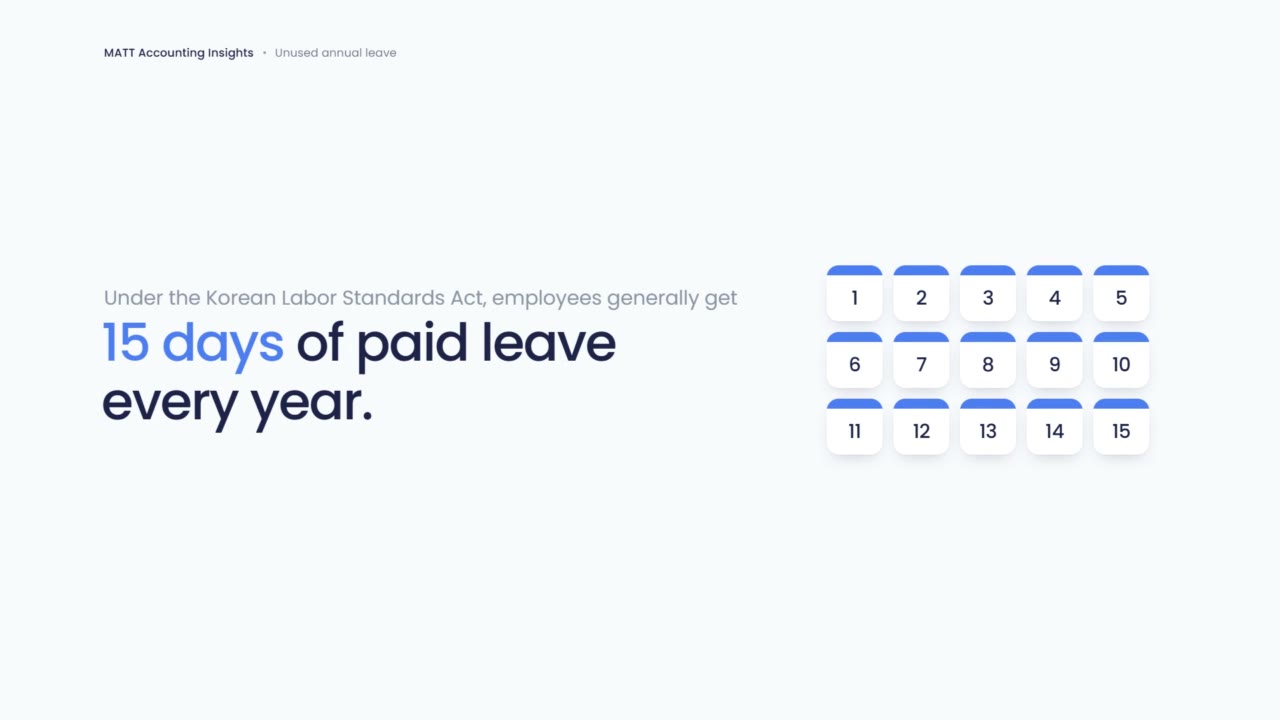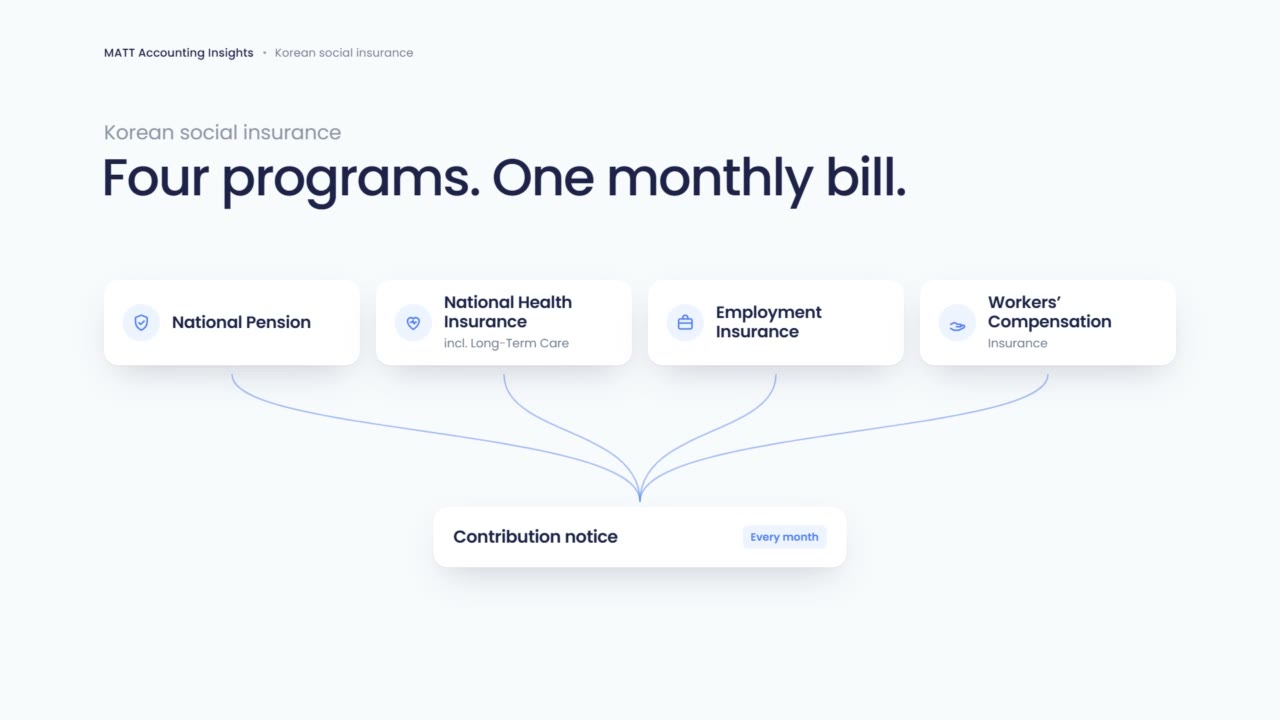
In a previous article, we discussed why unused annual leave is not merely an HR issue but also a matter that affects payroll, tax reporting, retirement benefits and financial statements.
This article uses a practical example to illustrate how financial statement impacts can differ depending on whether a company follows:
- the Cash Settlement Method; or
- the Accrual Accounting Method.
Although both approaches may ultimately result in the same total expense over the employee’s service period, the timing of expense recognition and liability recognition can differ significantly.
Example
Assumptions
- One employee joined the company on January 1, 2023
- Ordinary daily wage:
- 2023: KRW 200,000
- 2024: KRW 300,000
- 2025: KRW 400,000
- 15 days of annual leave are granted on January 1 of the following year based on the employee’s service during the preceding year.
- During 2024:
- 9 days used
- 6 days unused
- Unused leave compensated in February 2025
- During 2025:
- 10 days used
- 5 days unused
- Unused leave compensated in February 2026
- The employee resigns on October 31, 2026
- Before resignation, the employee uses 12 days of annual leave
- Remaining annual leave is compensated through the final payroll upon termination
Expense Table
| Year | Expense Recognized – Method 1 | Expense Recognized – Method 2 | Difference |
|---|---|---|---|
| 2023 | 0 | 3,000,000 | 3,000,000 |
| 2024 | 1,200,000 | 2,700,000 | 1,500,000 |
| 2025 | 1,500,000 | 3,000,000 | 1,500,000 |
| 2026 | 0 | (6,000,000) | (6,000,000) |
Comparing the Two Methods
| Item | Cash Settlement Method | Accrual Accounting Method |
|---|---|---|
| Focus | Cash payment timing | Service period |
| Liability recognition | Only when settlement becomes payable | As the obligation is earned |
| Year-end obligations reflected | Limited | More comprehensive |
| Financial statement matching | Weaker | Stronger |
| Administrative complexity | Lower | Higher |
Key Observation
Many companies focus only on annual leave compensation payable.
However, from a financial reporting perspective, a more important question is:
Have the obligations arising from employee service already been reflected in the financial statements?
This is the fundamental difference between the Cash Settlement Method and the Accrual Accounting Method.
Key Takeaway
Over the employee’s entire service period, both methods ultimately recognize the same total cost.
However, companies adopting the Cash Settlement Method may understate annual leave-related liabilities and expenses in certain reporting periods.
For companies preparing audited financial statements, management should ensure that annual leave obligations are evaluated not only from a labor law perspective but also from an accrual accounting perspective.
This distinction becomes particularly important for foreign companies that report under K-IFRS or group reporting frameworks that emphasize accurate liability recognition and period matching.