When foreign companies establish a subsidiary in Korea, discussions usually focus on capital requirements, corporate structure, hiring plans, and office locations.
However, before any of those decisions are finalized, there is one fundamental question that should be answered first:
What business activities will the Korean subsidiary actually perform?
The answer is important because every Korean company must be assigned an industry classification and business code.
In practice, this classification will be reflected in:
- the Foreign Investment Report;
- the business purposes recorded in the corporate registry;
- the business registration filed with the National Tax Service; and
- various regulatory and tax filings throughout the life of the company.
Although many companies view the classification process as an administrative formality, it can have significant legal, regulatory, and tax implications.
Why Industry Classification Matters
Based on our experience assisting foreign-invested companies in Korea, industry classification often affects three key areas.
1. Business Licenses and Regulatory Requirements
Certain industries require additional licenses, registrations, or permits beyond the standard incorporation and tax registration procedures.
For example, companies performing construction work are generally required to register as a construction business and satisfy specific requirements relating to:
- minimum capital;
- qualified engineers; and
- office facilities.
However, a company that merely provides engineering consulting, project management, or equipment supply services may fall under a different industry category and be subject to entirely different requirements.
Selecting the correct industry classification from the outset helps avoid unexpected regulatory issues and unnecessary compliance costs.
2. How the National Tax Service Evaluates Your Company
The Korean National Tax Service (NTS) relies heavily on automated data analysis.
One of the first data points used in that analysis is the company’s registered industry code.
If the registered code does not accurately reflect the company’s actual activities, several issues may arise:
- The company may be expected to comply with obligations that do not apply to its business.
- It may be questioned regarding requirements that have already been satisfied.
- It may be compared against an inappropriate peer group.
For example, a company generating a normal operating margin of 3% may be compared with businesses in an industry where a 15% margin is common. In such cases, the tax authorities may ask the company to explain why its reported profitability appears unusually low.
3. Tax Benefits and Special Tax Rules
Industry classification can also affect the application of Korean tax incentives and special tax provisions.
Examples include:
- Qualification as a Small and Medium-sized Enterprise (SME);
- Eligibility for certain tax credits and tax reductions;
- Application of special provisions under the Restriction of Special Taxation Act; and
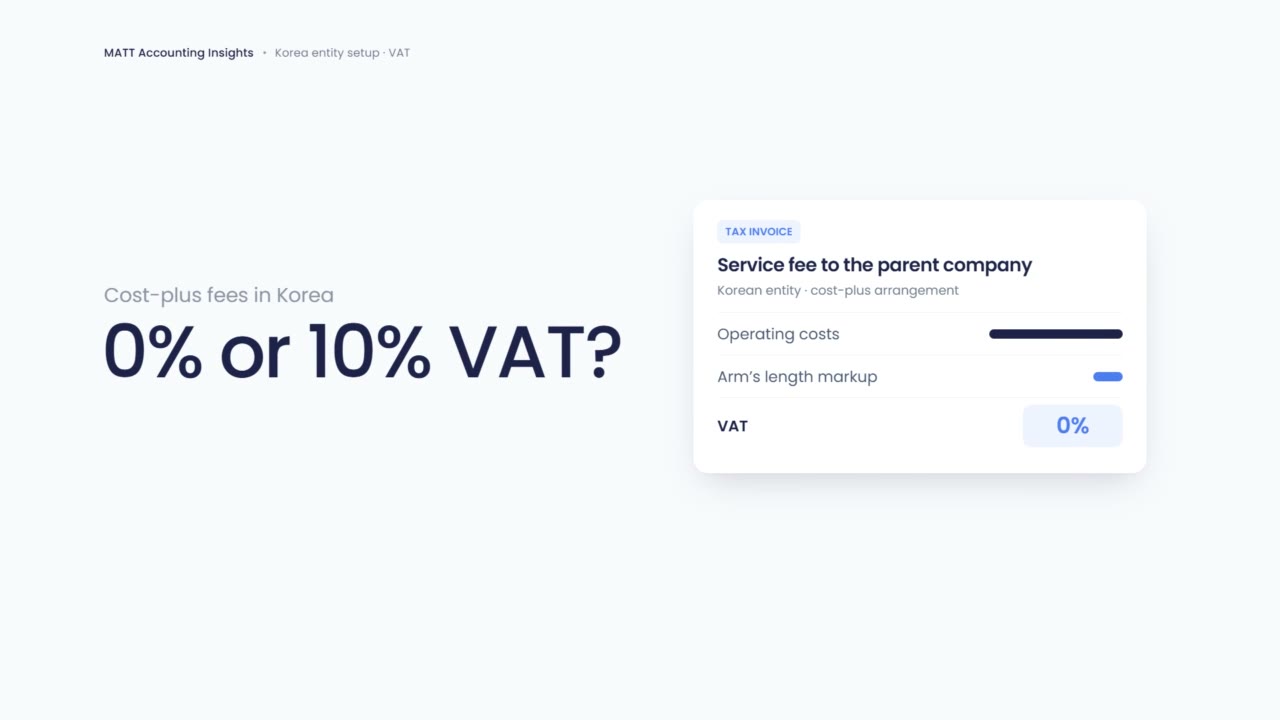
- Eligibility for the 0% VAT rate on certain services provided to foreign companies.
In other words, an incorrect classification may impact not only compliance requirements but also the tax benefits available to the company.
A Common Mistake: Using the Parent Company’s Industry
One mistake we frequently see is foreign groups simply describing the Korean subsidiary in the same way as the parent company.
Consider a U.S. software company.
The parent company may develop software products, own intellectual property, and sell software directly to customers worldwide.
However, the Korean subsidiary may:
- provide sales support services;
- conduct marketing activities;
- communicate with Korean customers; and
- receive a service fee from the parent company under a cost-plus arrangement.
In that situation, the Korean subsidiary is generally not engaged in software development or software sales.
Instead, it is often classified under a business support service category.
The key principle is straightforward:
Industry classification should be based on what the Korean subsidiary actually does, not on what the parent company does.
Questions to Ask Before Selecting an Industry Code
Before incorporating a Korean subsidiary, we generally recommend addressing the following questions:
Who will sign contracts with Korean customers?
Who will issue invoices to Korean customers?
Where will revenue be generated?
What activities will Korean employees actually perform on a day-to-day basis?
Will any licenses, registrations, or permits be required?
The answers often provide a clear indication of the most appropriate industry classification.
Final Thoughts
Industry classification may appear to be a minor administrative step during the incorporation process. In reality, it can influence licensing requirements, regulatory obligations, tax reporting, and eligibility for various tax benefits.
For that reason, foreign investors should evaluate the Korean subsidiary’s actual business activities and operating model before selecting an industry classification.
In our experience, companies that spend time getting this right during the planning stage can avoid significant compliance and tax issues later as their Korean operations grow.
Key Takeaway
When determining the industry classification of a Korean subsidiary, focus on what the Korean entity will actually do, not on the business activities of the parent company.